

Colorectal Cancer
What Is Colorectal Cancer
Colorectal cancer is one of the cancers on the rise in Japan. Symptoms such as blood in the stool and changes in bowel habits may appear, but in the early stages there may be no clear symptoms, and the cancer is sometimes not discovered until it has advanced.
As it progresses, it may spread (metastasize) to the liver, lungs, lymph nodes, peritoneum, bones, and other areas.
General Treatment
Treatment for colorectal cancer is selected based on the stage and extent of the cancer.
- Early-stage cancer: Endoscopic treatment (polypectomy, ESD, etc.)
- Advanced cancer: Surgery (colectomy) and chemotherapy
- With metastasis: Systemic drug therapy is the primary approach
Characteristics and Treatment of Metastasis
In colorectal cancer, liver metastasis and lung metastasis are particularly common. Lymph node metastasis and peritoneal dissemination may also occur, making a treatment strategy tailored to each patient's condition essential.
While systemic treatment such as chemotherapy is generally the primary approach, combining local treatment depending on the number and location of metastases may allow for better disease control in some cases.
At our clinic, we use imaging diagnosis to assess the full extent of disease in detail and evaluate incorporating IVR (image-guided therapy) into the treatment plan.
For details on each type of metastasis, please see below.
- Detailed explanation of liver metastasis
- Detailed explanation of lung metastasis
- Detailed explanation of lymph node metastasis
- Detailed explanation of bone metastasis
IVR Treatment at Our Clinic
For colorectal cancer, local treatment using IVR may be considered, particularly for liver metastasis and lung metastasis.
At our clinic, we offer:
- Radiofrequency ablation (RFA) — A fine needle is inserted into the tumor and the lesion is treated using heat.
- Catheter treatment (embolization, etc.) — We approach the blood supply feeding the tumor and perform local control tailored to the patient's condition.
By combining these treatments according to each patient's individual condition, we provide care while minimizing the physical burden on the body.
What Is Peritoneal Dissemination
In colorectal cancer, cancer cells can sometimes spread throughout the abdominal cavity—a condition known as "peritoneal dissemination." It tends to occur in advanced cases, and until now effective treatments have been limited. Treatment is often difficult, and depending on the patient's overall condition and disease status, control can be challenging.
For this reason, efforts are underway to expand treatment possibilities for patients who previously had limited options, by introducing new therapies alongside conventional treatment.
Our Clinic's New Treatment for Peritoneal Dissemination
At our clinic, we offer our own proprietary perfusion therapy for peritoneal dissemination.
Patent obtained (Patent No. 7773673, filed July 30, 2025).
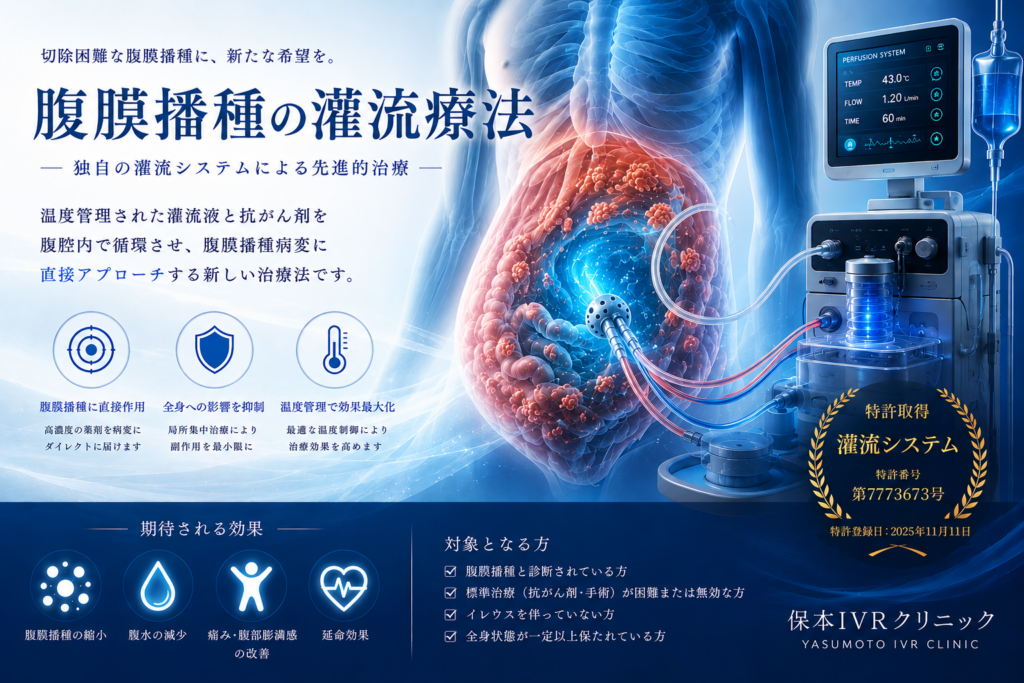
This treatment directly accesses the abdominal cavity, delivering intensive treatment to the tumor while aiming to improve therapeutic efficacy with minimal systemic burden.
It may offer a new treatment option even for cases that were difficult to address with conventional treatments.
For details, please refer to
the detailed explanation of perfusion therapy
.
Please Consult Us If...
- Are considering local treatment options for colorectal cancer metastasis
- Are looking for options beyond chemotherapy
- Have been told that surgery is not possible
- Are struggling with the side effects of chemotherapy
- Are interested in new treatments for peritoneal dissemination
At YASUMOTO IVR Clinic, our IVR specialists, guided by imaging diagnosis, combine RFA, catheter treatment, and perfusion therapy to provide care tailored to each patient's individual condition. Even when surgery is difficult, we explore treatment options that leverage the unique strengths of IVR and determine the most appropriate treatment plan.
If you have any questions, please feel free to consult us.


